
Left-turn accidents are a frequent and often serious type of collision. Turning across oncoming traffic requires judgment and timing, and a mistake can lead to a significant crash. Right-of-way rules generally place responsibility on the turning driver, though not in every situation. Understanding how fault is determined in left-turn accidents, and the role of right-of-way, helps injured people grasp how responsibility is analyzed when a collision occurs during a turn.
The Challenge of Turning Across Traffic
A left turn often requires crossing the path of oncoming traffic, which makes it one of the more demanding maneuvers a driver performs. The turning driver must judge the speed and distance of oncoming vehicles and complete the turn safely. A misjudgment can place the turning vehicle directly in the path of oncoming traffic. Because of this challenge, left-turn accidents are common and can be severe. Understanding the difficulty of turning across traffic helps clarify why these collisions occur and how fault is analyzed.
Right-of-Way and the Turning Driver
Right-of-way rules generally require a driver making a left turn to yield to oncoming traffic. The turning driver is expected to wait until it is safe to complete the turn without interfering with vehicles that have the right-of-way. For this reason, the turning driver often bears responsibility when a left-turn collision occurs. This general rule reflects the expectation that a driver crossing oncoming traffic must yield. Understanding it helps clarify why the turning driver is frequently found at fault in these accidents.
When the Turning Driver May Not Be at Fault
Although the turning driver often bears responsibility, this is not always the case. An oncoming driver who was speeding, ran a red light, or was driving in a way that made the collision unavoidable may share or bear fault. If the turning driver began the turn safely and an oncoming driver’s misconduct caused the collision, responsibility may shift. Understanding that the turning driver is not automatically at fault helps clarify why the conduct of the oncoming driver also deserves examination in a left-turn accident.
The Role of Traffic Signals
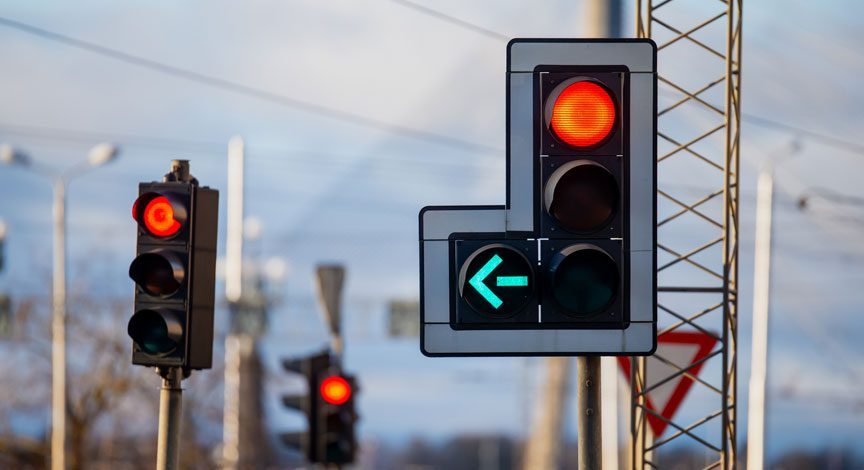
Traffic signals often play an important part in left-turn accidents. A protected turn signal changes the right-of-way, giving the turning driver priority. A collision that occurs during a protected turn raises different questions than one during an unprotected turn. Whether a signal permitted the turn, and whether an oncoming driver disregarded a signal, can be central. Understanding the role of traffic signals helps clarify how the right-of-way at the moment of a left-turn collision is determined and how it affects fault.
Evidence That Clarifies What Happened
Establishing fault in a left-turn accident depends on evidence about how it occurred. The positions and damage of the vehicles, the timing of the turn, the state of any traffic signals, and witness accounts all help clarify the sequence of events. Any available footage can be especially valuable. Because these accidents often turn on questions of timing and right-of-way, careful evidence is important. Collecting this information supports an accurate account of the collision and where responsibility lies.
Injuries in Left-Turn Collisions
Left-turn collisions can cause serious injuries, particularly when a turning vehicle is struck by oncoming traffic or when a vehicle is hit on its side. The forces involved can be significant, and the injuries can be severe. A full medical evaluation is important, as some injuries may not be immediately apparent. Recording the injuries and tying them to the collision helps show how serious they are. Understanding that left-turn accidents can cause substantial harm underscores the importance of proper medical attention.
Understanding Fault in a Left-Turn Accident
Fault in a left-turn accident often falls on the turning driver, reflecting the duty to yield to oncoming traffic. Understanding the role of right-of-way, the situations where the oncoming driver may share fault, and the importance of traffic signals helps injured people make sense of their situation. While the turning driver frequently bears responsibility, the conduct of the oncoming driver and the circumstances of the turn still deserve careful examination.